MCP Is Turning Shadow IT Into An Authority Problem
Vinay Patankar · 19 Apr, 2026 · Technology

Shadow IT used to be an app problem. Someone bought a SaaS tool without approval. Someone uploaded company data. Someone forgot to revoke access when an employee left. It was messy, but the shape of the problem was obvious.
MCP changes the shape of the problem. The Model Context Protocol gives AI agents a standard way to connect to tools, data, and systems. That sounds like an integration detail. I think it is actually an authority problem.
Because once an agent can call tools, read context, update records, trigger workflows, and move work between systems, it stops behaving like software someone uses. It starts behaving more like a junior operator with API access. That is a very different thing to govern.
What changed
The story that makes this real is Azure MCP Server 2.0. Microsoft shipped it with 276 tools across 57 Azure services, plus support for remote MCP servers teams can host themselves. That is not a toy. That is enterprise infrastructure.
And the more useful this gets, the faster it will spread inside companies before anyone has a clean governance model for it.
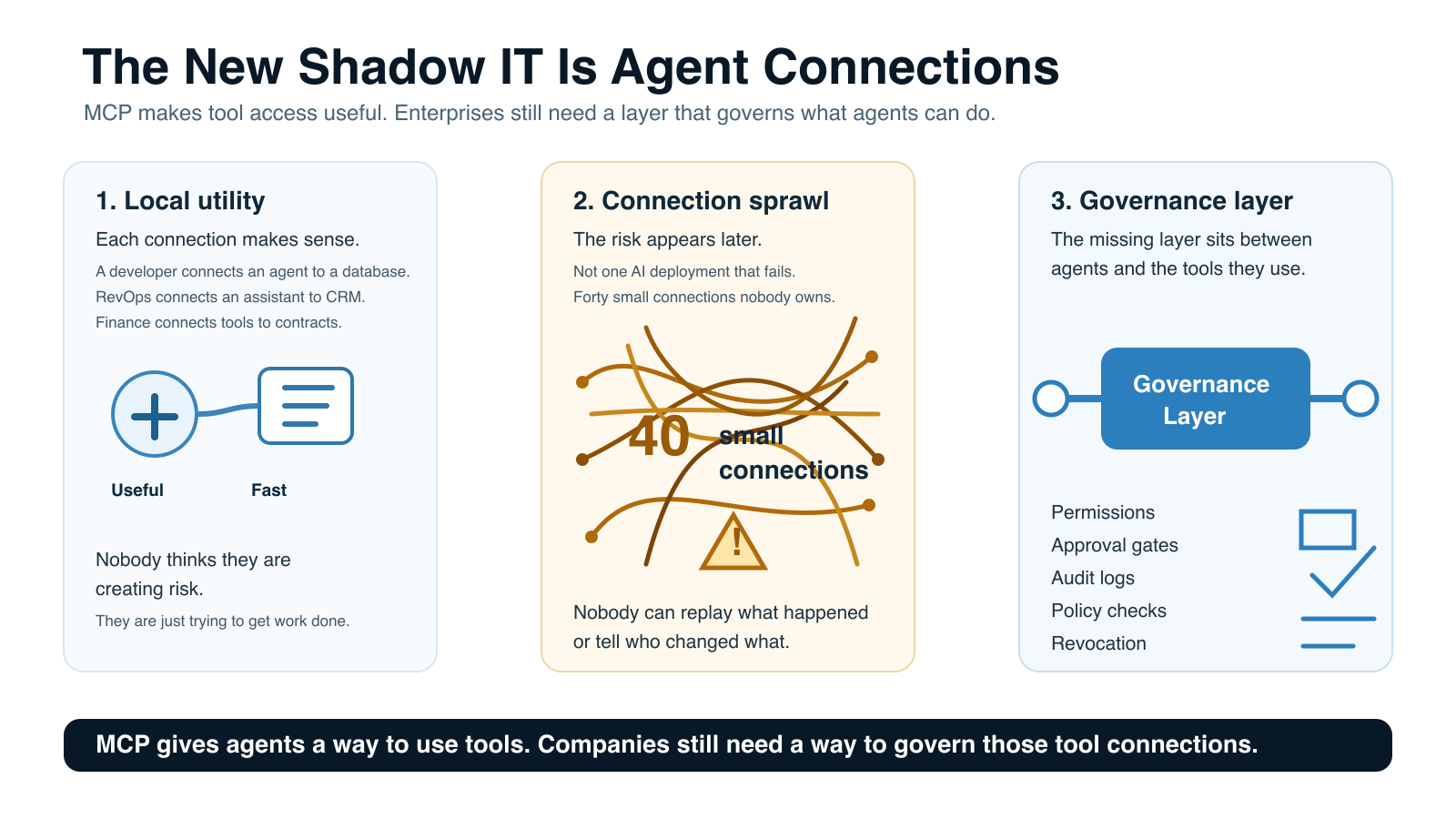
First, an engineer connects Claude Code or Cursor to a database because it saves them time. Then a platform team exposes Azure tools through a shared MCP server. Then RevOps connects an agent to Salesforce. Then finance lets an assistant read invoices, contracts, and spreadsheets. Then operations wires agents into ticketing, Slack, Drive, HubSpot, GitHub, and internal tools.
Every one of those decisions makes sense locally. That is the problem. Nobody thinks they are creating a governance mess. They are just trying to get work done, and the fastest path is to give the agent one more connection, one more tool, one more permission, one more workflow.
That is how shadow IT always starts.
What people are missing
The old shadow IT problem was unsanctioned software. The new one is unsupervised capability.
That distinction matters.
A SaaS app mostly stores information, moves files, and gives humans a place to work. An agent connected through MCP can use the stack. It can read from one system, call another tool, update a record, trigger a workflow, send a message, or create a downstream action that looks like normal work.
So the governance question is not just, “Who has access to this app?”
It becomes, “What authority did we just give this agent?”
That is a harder question because authority is not one permission. It is a chain of permissions across a workflow. Reading a contract may be fine. Extracting payment terms may be fine. Updating a vendor record may be fine. Triggering an approval flow may be fine. But once those actions are connected, you have created a piece of operating infrastructure.
And if nobody designed that infrastructure on purpose, it becomes very hard to unwind.
How it actually breaks
Okta’s recent agent security push is a good signal here. They reported that 88% of organizations have suspected or confirmed AI agent security incidents, but only 22% treat agents as independent identities. That gap feels important.
Companies are going to have agents that can summarize, query, update, delete, message, route, deploy, approve, and trigger workflows. But many of those agents will not have a clean identity. They will not have a clear owner. They will not have a permission model that maps to the work they can actually do. And the audit trail will often blur together human action, agent suggested action, and agent executed action.
This is where it gets weird inside real companies.
A customer update touches sales, support, billing, legal, and finance. A hiring workflow touches HR, IT, security, payroll, and compliance. A vendor workflow touches procurement, contracts, approvals, payments, and audit. Now put agents in the middle of those workflows.
The risk is not that one giant AI deployment goes wrong. The risk is that 40 small agent connections each seem harmless, then six months later nobody can explain which agent can touch which system, which data went where, or why something changed.
This is the practical version of the agent bosses problem: someone has to supervise systems that now do work.
That is not really a model problem. It is an operating system problem.
The missing layer
MCP gives agents a standard way to use tools. Companies now need a standard way to govern what those agents are allowed to do with those tools.
That means permissions, but permissions are not enough. It also means approval gates, policy checks, audit logs, environment boundaries, revocation, human handoff, and the ability to shut down one capability without breaking the whole workflow.
The boring stuff, basically. But this is usually where enterprise software becomes real. Not in the demo. In the layer that makes the demo safe enough to run across a company.
Shadow IT used to mean unauthorized apps. MCP turns it into authorized agents with unclear authority. That is the category shift.
The next serious layer in enterprise AI is not another agent demo. It is authority management for agents.